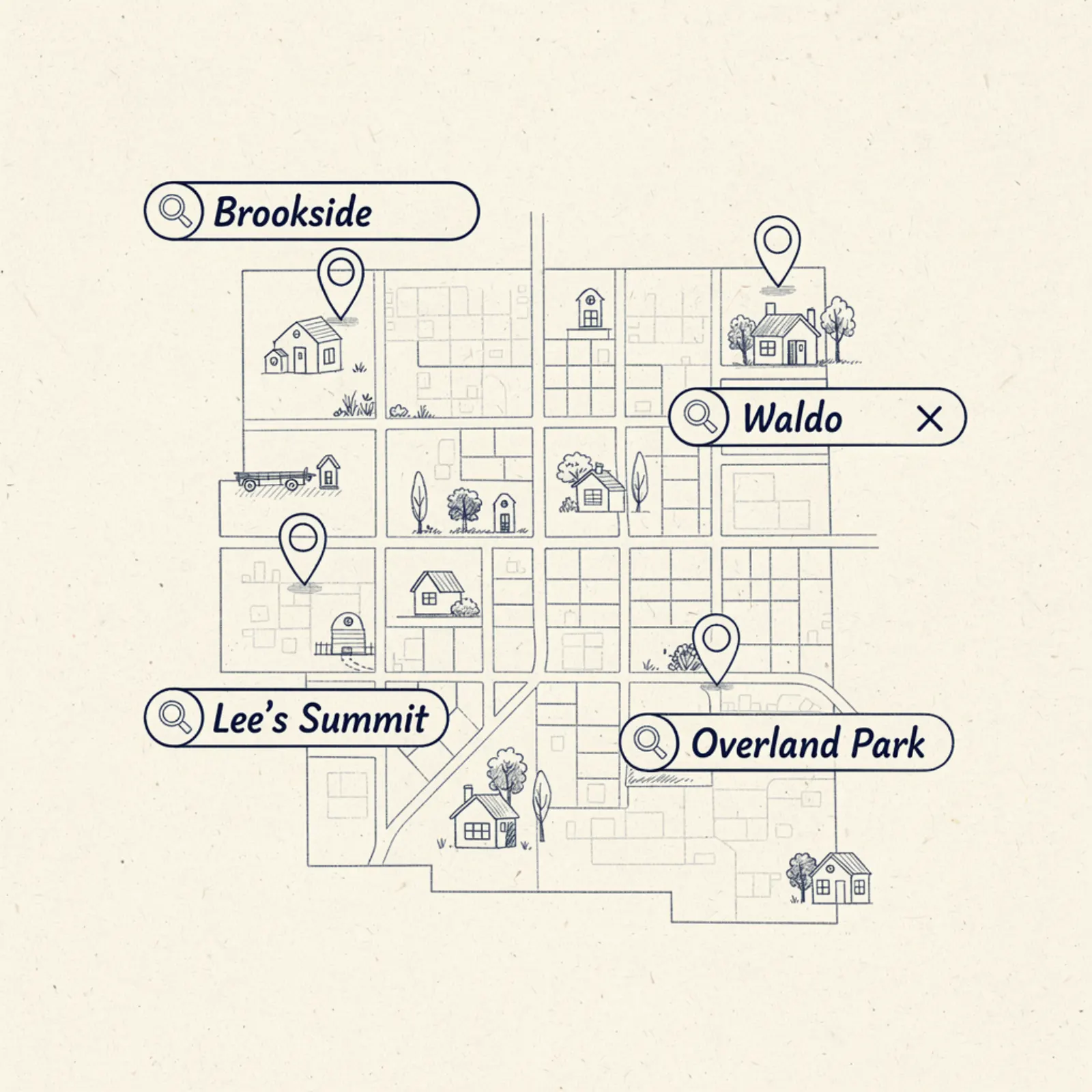
Most small businesses rank for exactly one thing: their own name. If someone already knows you exist, they find you. If they don't, you're invisible.
The searches that actually produce new customers look nothing like a brand search. They're intent-driven, often location-specific, and typed by people who want to hire someone today. Google has gotten very good at matching those searches to specific local businesses — but only the ones whose websites and profiles are structured to receive them. Here are the 9 patterns those searches follow, and the practical steps to show up in each one.
1. "[Service] near me"
This is the highest-volume local search pattern by a wide margin. "Photographer near me." "Coffee shop near me." "Dentist near me." Google resolves "near me" using the searcher's device location, so you don't put the words "near me" on your website — you just need to be well-optimized for your actual location. What drives this: your Google Business Profile completeness, your review count, and how closely your primary GBP category matches the search intent.
A coffee shop with a complete GBP, 200+ reviews, and the primary category set to "Coffee shop" will show up consistently for "coffee shop near me" in its area. One with a sparse profile and a generic "Food and beverage" category often doesn't. The fix is the same for any business type: claim your GBP, set the right primary category, fill in every field, and get reviews flowing. That's the foundation that every other pattern builds on.
2. "[Service] in [City]"
The second most common pattern. "Portrait photographer in Austin." "Bookkeeping for small businesses in Denver." "Yoga studio in Portland." This is the query your website homepage needs to be built around — not "we're the best," but the plain-English combination of what you do and where you do it. If your homepage title tag doesn't include your city and your primary service, you are not ranking for this pattern.
Most small business websites get this wrong. The title tag says the business name. The homepage headline says "Welcome." The body copy never mentions the city. Google crawls it and has no idea where the business operates or what it does. The fix takes 20 minutes: rewrite your title tag to "[Service] in [City] — [Business Name]," put your city in your first paragraph, and use structured data (LocalBusiness schema) to tell Google your address explicitly.
3. "[Service] + [Neighborhood or Suburb]"
People narrow down fast. A coffee shop searcher in a big city doesn't search "coffee shop in Chicago" — they search "coffee shop in Logan Square" or "coffee shop near Wicker Park." A photographer client doesn't search "photographer in Dallas" — they search "family photographer Plano" or "newborn photographer Frisco." If your business draws from specific neighborhoods or suburbs, you need pages that name those places explicitly.
One dedicated page per area you want to rank in — with real content about serving that area, not just a template with the city name swapped. A mobile detailer might have a page for each suburb they cover regularly. A dentist might have separate landing pages for each neighborhood their patients come from. These pages compound. Once they rank, they keep pulling in traffic without additional effort.
4. "[Service] + [Qualifier]"
Qualifiers are the words people add when they have a specific constraint: "affordable," "female-owned," "open Sunday," "same-day," "no appointment needed." A boutique retailer with Saturday hours gets real traffic from "boutique open Saturday [city]." A mobile detailer who comes to your office gets traffic from "mobile car detailing [city]." These qualifiers often have low competition and very high conversion rates because the searcher already knows exactly what they want.
Look at your own business and ask: what do people ask about before they book? Whatever comes up on first calls — hours, price range, parking, whether you take walk-ins — those are your qualifiers. Put them in your page copy and your GBP description. They're free traffic that your competitors are ignoring because they're chasing the high-volume head terms instead.
5. "Best [service] in [city]"
"Best" searches are heavily influenced by Google's map pack and review count. A coffee shop with 400 reviews and a 4.7 rating will outrank one with 40 reviews and a 5.0. The word "best" is a trust signal search — Google shows the businesses with the most social proof. You don't have to be the best to rank for "best"; you have to have the most verifiable evidence of quality.
That means consistent reviews over time, not a one-time push. A gym that collects 5 reviews a month for 12 months has better signal than one that got 50 reviews in a single week and then nothing. It also means responding to reviews — both positive and negative. Google treats an actively managed profile as a signal of a legitimate, customer-focused business. That management work directly affects your map pack position.
6. "[Problem description]" searches
Some customers don't know what they need — they describe a situation. "What do I do if my books are a mess." "Why does my website look bad on phones." "How to get more clients as a photographer." These are informational searches, and they drive traffic to your site if you have pages that answer them directly.
A small accounting practice that publishes "What to do when you're behind on bookkeeping" will attract exactly the right reader at exactly the right moment — someone who needs help and is about to call someone. A music teacher who writes "How to choose between group lessons and private lessons" captures parents in the decision stage. You don't have to produce a blog with 50 posts. Three good answers to real questions people ask you on the phone is a useful start, and it already puts you ahead of most local competitors who have no content at all.
7. "[Service] + [Occasion or Context]"
"Wedding photographer [city]." "Catering for corporate events." "Gym with childcare." "Dentist for kids." People add context when they're searching for something with a specific use case. If you specialize in a particular type of client or occasion, say so explicitly — on a dedicated service page, not just in a footnote on your about page.
A photographer who lists wedding, newborn, and senior portrait as separate services (not lumped under "photography") will rank for all three separately. A gym that has a page dedicated to "early morning classes for busy professionals" can rank for that context even in a competitive market. An accounting practice that has a separate page for freelancers versus LLCs versus nonprofits will rank for searches from all three groups. Context-specific pages take more work to build but they convert at much higher rates than generic service pages.
8. "[Competitor type] alternative" or "[Competitor name] reviews"
These searches are underused by small businesses. People comparison-shop before they commit. A music teacher might capture "piano lessons vs self-taught" or "better than [the big national app]" searches with a single page explaining their teaching approach and what makes in-person instruction different. A local coffee shop can rank for comparisons if it has content that honestly explains the experience difference versus a chain.
These aren't high-volume keywords — but the people searching them are deep in the decision process. They've already decided they want the category. They're comparing options. A business that shows up here with a clear, honest answer is one good page away from a new customer who is actively choosing between competitors.
9. "[Your business name] + reviews" or "[Your business name] + [city]"
Branded searches happen when someone heard about you from a referral, saw your sign, or got a card from you and wants to verify you're legit before they call. This is the one search type where you're almost guaranteed to rank — but only if you have a GBP, a real website, and some reviews visible. A gym with no website but a complete GBP will still show up. A photographer with a nice website but no GBP may not.
The floor here is to have both, have them complete, and make sure the information matches across every platform — same phone number, same address, same hours on your website as on your GBP as on Yelp. Inconsistency across platforms is a trust signal to Google that something is wrong. Consistent NAP (name, address, phone) across all listings is a basic local SEO requirement that many small businesses overlook.
What to do with this
You don't need to attack all 9 patterns at once. Pick the two that match where your customers are most likely searching right now. For most local businesses, that's pattern 2 ("[service] in [city]" — fix your homepage title and first paragraph) and pattern 5 ("best [service]" — build your review count systematically). Do those two things well and you'll outrank the majority of local competitors who haven't thought about any of this.
After that, add one neighborhood or suburb page per quarter for pattern 3. Write one FAQ post per quarter for pattern 6. Keep your GBP categories and service list current for patterns 1, 4, and 7. Compounded over a year, that's a real local search presence — built steadily in the background while you're running your actual business.
Want a site built for your business?
$500 setup. $129/month. Live in 14 days. Start with a free mockup.
Get my free mockup