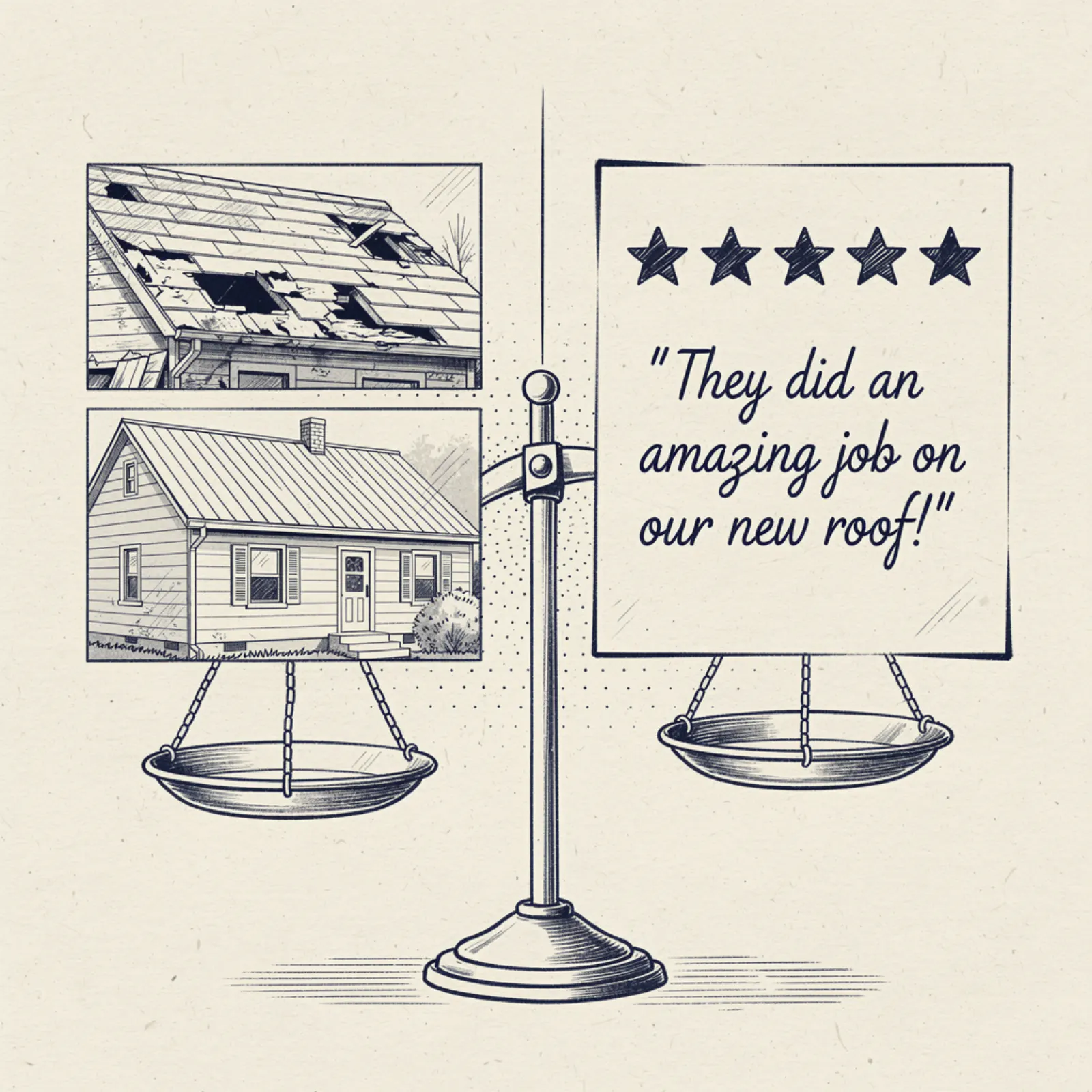
You have before-and-after photos from your best jobs. You have a stack of 5-star Google reviews. Both are social proof — evidence that you do good work. But they don't work the same way and they don't work for the same type of visitor.
What a gallery does
A before-and-after gallery — or just an "our work" gallery — is visual proof of your technical competency. It answers: "Can this company actually do the thing I need?" It's most powerful early in the buying process, when a customer has found you but hasn't yet decided whether to trust you with the job.
For business owners where the quality of the finished work is highly visible — landscaping, interior design, house painting, photography, food — a gallery is often the single most important trust signal on the site. A well-curated gallery of real work shows exactly what a customer can expect. That sells itself.
For business owners where the work is mostly invisible — bookkeeping, legal services, IT support, coaching — a gallery is less viscerally convincing. A photo of a completed tax return doesn't create the same emotional impact as a before-and-after landscaping project. For these businesses, the written testimonial does more work.
What testimonials do
Testimonials — real customer quotes with names — answer a different question: "Can I trust this person in my home?" They address the trust and character questions that a gallery can't answer. "Mike showed up on time, explained everything clearly, and the price was exactly what he quoted" tells a prospective customer something no amount of work photos can.
Testimonials are most powerful late in the buying decision, when someone has already decided you're technically capable and is now deciding whether to actually hire you versus a competitor who also seems capable.
The combination that works
Use both, in the right places. A gallery near the top of the page for visual-heavy business owners, or on a dedicated "Our Work" page. Testimonials prominently on the homepage and on the contact page — where the buying decision is actually happening.
The homepage formula that converts well for any business: your hero (what you do, where you do it, call-to-action), then a 3-4 item testimonial strip right after the hero (trust signals early), then your services and gallery mid-page, then a few more testimonials near the contact form at the bottom.
The testimonial quality filter
Not all testimonials are equal. "Great service!" is useless. "Sarah photographed our family reunion and the photos were absolutely incredible. She was patient with the kids, had everything set up before we arrived, and delivered the full gallery in under two weeks. We've already booked her for next year." That's a testimonial that converts. It's specific, credible, and tells the next customer exactly what to expect.
The best testimonials are specific: what service, what was notable about the experience, what quantifiable outcome if there is one. When you're gathering reviews, after a particularly good job you can prompt the customer: "If you're going to leave a review, the most helpful things to mention are [what you needed], [what you liked about how we handled it], and [what outcome you saw]. That kind of detail really helps people who are trying to decide."
Video testimonials convert at 3x
If any of your happy customers are willing to do a 30-second phone video — "I worked with [company] and here's what happened" — put that on your site. A real person on camera is worth more than 10 written testimonials. Not every customer will do it, but asking directly right after a successful engagement gets you one every few months. Over a year you'll have 4-6 video testimonials that are worth more than your whole written review portfolio.